Hi @VHough,
That’s a great question, and this is a common challenge. I will leave the curatorial perspective to others who have insight to share, but the Specify platform has a preferred way of handling it that captures historical context.
Specify’s principle on agents is that each unique person, group, or organization should have only one Agent record. With this approach, you avoid the ambiguity and it makes it easy to search for all specimens collected by a person, regardless of what point in their life it took place.
The best practice in Specify is to use the current, most up-to-date name for the primary Agent record and to store all previous names as Agent Variants.
This is a more structured approach than using the remarks field because it allows you to categorize the type of name change.
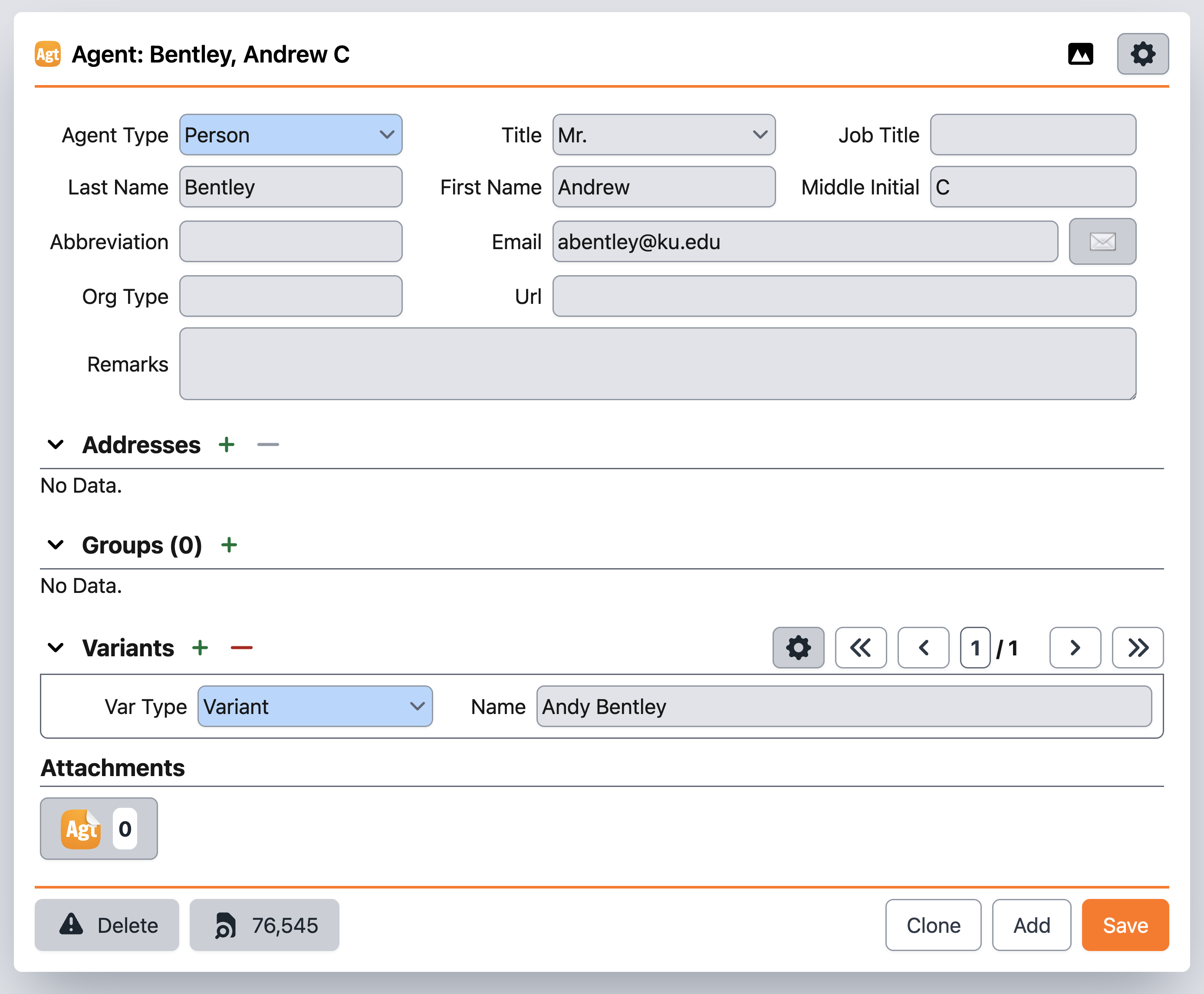
For your specific scenarios:
- For a department that changed its name from “Department of Game” to “Department of Wildlife,” the primary Agent record’s name would be “Department of Wildlife.” You would then create an Agent Variant with the name “Department of Game” and select (or create) a
Typelike “Former Name.” - The same logic applies for a personal name change. The primary record for the person should use their current legal name. You would then add their maiden name as an Agent Variant, with a
Typeof “Maiden Name”, “Variant Name”, "Birth Name, or “AKA.”
In short, we recommend showing and using the last “correct” name while capturing any variants as attributes of the agent on the form.
In addition to capturing variants, we encourage you to add ORCID and/or Wikidata IDs to agents using the Agent Identifiers system. This will allow you to uniquely identify them, regardless of any future name or status changes: