The Specify Collections Consortium (SCC) is thrilled to extend its reach to geology with GeoSpecify, a database platform for curating research collections of rock, mineral, meteorite, core, and other kinds of geosamples. GeoSpecify is a new subsystem integrated into Specify 7.12. It takes advantage of Specify’s current capabilities and codebase and will be embedded and supported in all future Specify releases. Whether you are starting a wholly new geological data repository or adding a geological collection to an existing BioSpecify site, GeoSpecify is ready to manage earth science collection data.
GeoSpecify is the result of a three-year engagement among geoscientists of the Swiss Natural History Museums of Bern, Basel, Geneva, Lausanne, and SCC staff. We gratefully acknowledge the investment of the Swiss Academy of Sciences which funded the work as part of the Swiss Natural History Collections Network “SwissCollNet” Program. We must also acknowledge the vision and leadership of Drs. Beda Hoffman and Thomas Burri of the Bern Natural History Museum, for their scientific expertise and commitment to guide the GeoSpecify collaboration to a successful completion.
Geoscience Collection Perspectives and the Specify Data Model
In contrast to most biological collections, the nature of geological samples promote the use of broader collection information concepts and additional kinds of logical data linkages. For example, supporting the separate description and cataloging of individual minerals and fossils embedded within a single (cataloged or uncataloged) substrate is essential, particularly with respect to the disciplinary description standards and assignment of unique identifiers that pertain to the distinct biological and geological components embedded within a single physical object.
As a result of the unique ways geologists think about collection objects, we elaborated the Specify data model to more effectively reflect and describe the logical and physical relationships that define groups of related collection objects. We analyzed the heterogeneity of geological object types, and the variation among collections in how they identify and describe the components of a single physical object (e.g. a rock or a core), then extended Specify’s data model to add the concepts of Collection Object Groups, (Collection Object) Components and Collection Object Types.
These new concepts, shown in the partial data model diagram below, are now fully-implemented in Specify’s back-end data processing, APIs, form design, queries, user interface, and data export mapping. The new database elements provide flexibility for configuring a geocollection digital catalog to reflect an institution’s legacy cataloging protocols, Collection Object description priorities, and rules for the application of identifiers.
Figure. A snippet of GeoSpecify’s data model showing the the newly added Collection Object Group, Collection Object Component, Collection Object Type, and their relationships. Geologic Context brings in hierarchical tree-structured data associated with Locality, Collecting Event, and Collection Object information.

Collection Object Groups (COGs)
Specify Collection Objects that share much of the same information because of their physical integrity in a single object can now be logically associated as a Collection Object Group.
- Use Cases: A COG is a logical grouping of related Collection Objects; it accommodates two common cataloging scenarios. COGs can be used to associate multiple, catalogable specimens that are physically connected within a single substrate, or COGs can associate multiple cataloged pieces that are discrete, i.e. not physically connected, like fragments of a larger physical object.
- Flexibility: Recognizing COGs as a concept and as a way to associate related cataloged Collection Object records is optional. Some geocollections will use them as a way to parallel written legacy methods of specimen description and labeling, while other collections will prioritize other kinds of data recording to identify relationships among objects and will not have a need for COGs.
Components
Components allow for the granular identification, description and classification of sub-parts of a specimen within a single, cataloged Collection Object.
- The Matrix Challenge (solved another way): In Mineralogy or Paleontology, where a single matrix, rock, plate, or substrate may contain multiple distinct biological or geological entities, some collections prefer to catalog the assembled constituents in a more granular way without the assignation of a catalog number for each element or the use of a Collection Object Group. In previous versions of Specify, it was impossible to describe the intrinsic and associative properties of a single component of a compound Collection Object.
- Resolution: The new concept of Components (of Collection Objects) enables that. Within a Collection Object record distinct parts can now have their own descriptions and associations to name classifications appropriate for that element type. This in effect creates a partial hierarchy of descriptive data and linkages within a single Collection Object record.
- Dynamic Typing: The new Specify
Typefield (e.g., “Fossil”, “Mineral”) determines which Taxonomy Tree acts as the authority for theNamefield for a Component identified as part of a Collection Object. In the GeoSpecify interface, selecting “Fossil” links the Component to a taxon in a biological classification; choosing “Mineral” links it to a geological classification tree.
Collection Object Types (COTs)
Another significant architectural advance in GeoSpecify is the addition of Collection Object Types. COTs are a way to group Collection Objects within a Specify collection database that share a common set of identifiers, taxonomy, and description standards and attributes, and which are different from other Collection Object Types within the same collection. In a sense, using COTs creates sub-Collections based on the type of sample being cataloged. In geology for example, COTs might include, within a single Specify database, specimens of minerals, rocks, meteorites, rock or ice cores, microscope slides, natural substrates, etc. Each of these types of Collection Objects can now co-exist in a Specify catalog respecting the legacy cataloging protocols, data and description standards unique for their COT. Being able to subset Collection Objects, within a Collection into classes or types, COTs also enable each type of object to have its own classification and catalog numbering system. This capability will have useful application beyond geology; it will enable biological collections to subset and manage different kinds of biological collection objects in a single heterogeneous collection catalog.
- Multiple Taxon Trees: A single collection can now support multiple taxon classifications, one for each Collection Object Type, simultaneously. This includes lookups, queries and other information retrieval functions.
- Consistent Cataloging: Promote consistency and structure of specimen description by using customized data entry forms for different Collection Object Types within a collection.
- Enhanced Information Retrieval: Filter searches within a single collection, by Collection Object Type, e.g., “Find all meteorites with attribute X” or “Find all rocks from locality Y”.
Geologic Context & Tectonic Units
GeoSpecify introduces a dedicated Geologic Context module (utilizing the paleocontext table structure). This group already contained Chronostratigraphy, Lithostratigraphy, and Biostratigraphy data, and now also includes support for a Tectonic Unit Tree, allowing for precise mapping of specimens to tectonic plates and terranes.
Advanced Age Tracking
Specify’s previous concept of a static date or era has been replaced with a dynamic history system.
- Relative & Absolute Ages: You can now capture the entire history of age determinations assigned to a specimen. Records support multiple determinations, allowing you to track how the understanding of a specimen’s age has evolved over time.
- Extended Age Queries: This powerful new search tool allows Paleontology and Geology collections to search for a specific name or period within the Chronostratigraphic Chart. Specify will locate all records dated precisely within that time frame, respecting the hierarchical nature of geologic time.
Enhanced Curatorial Tools
Beyond the extending Specify’s data model, this release adds practical tools to streamline daily curation:
- New Default Forms: Specialized forms for Geology include intuitive layouts for the new data types.
- Expanded Pick Lists: Out-of-the-box support for tracking Object Quality, Hazards, and Value.
- Conservation & Handling: New defaults for tracking conservation events, handling requirements, light exposure limits, and display recommendations specific to geological objects.
Attribution
GeoSpecify Advisory Committee
The GeoSpecify initiative was advised by the GeoSpecify Advisory Committee (GAC), which met in 2023 and 2024 to deliberate on geological collection concepts, requirements, and to provide feedback on development prototypes.
GAC Participant List
- Liath Appleton – Collections Manager, Jackson School Museum of Earth History, University of Texas
- Marie Angel – Curatorial Assistant, Geology, California Academy of Sciences
- Laurie C. Anderson – Director, Museum of Geology, South Dakota Mines
- Loren Babcock – Professor & Director, Orton Geological Museum
- Inês Gabriela Batista Pinto – Collections Manager, Museu Nacional de História Natural e da Ciência, Universidade de Lisboa
- Alexis Beck – Muséum d’Histoire Naturelle, Geneva
- Andrew Bentley – Specify Usability Lead & Ichthyology Collections Manager, University of Kansas
- Silvia Lusa Bernal – Head of Informatics, Real Jardín Botánico
- Franziska Böttger – Museum für Naturkunde Berlin
- Thomas Burri – Natural History Museum Bern
- David Cantrill – Royal Botanic Gardens Victoria
- Irina Dumitru – Collection Manager, Rocks & Minerals, Natural History Museum Oslo
- Ian Engelbrecht – University of Pretoria
- Una Farrell – Trinity College Dublin
- Nathaniel S. Fox – Associate Director, South Dakota Mines
- Nicolas Greber – Natural History Museum Geneva
- Mariah Green – Virginia Tech
- James Hagadorn – Denver Museum of Nature & Science
- Alexandra Hangsterfer – Geological Collections Manager, Scripps Institution of Oceanography
- Jonathan Hoffman – Santa Barbara Museum of Natural History
- Jens Klump – Group Leader, Exploration through Cover, CSIRO
- Ilya Kutuzov – Collection Manager, Geology & Mineralogy, Hebrew University’s National Natural History Collections
- Michael Leite – Chadron State College / Eleanor Barbour Cook Museum
- Kelsey Livingston – Laboratory Coordinator, Colorado School of Mines
- Gunnhild Marthinsen – University of Oslo, Natural History Museum
- André Puschnig – Naturhistorisches Museum Basel
- Manuel Sánchez Ruiz – Museo Nacional de Ciencias Naturales (CSIC)
- Leslie L. Skibinski – Invertebrate Paleontology Collection, Paleontological Research Institute (PRI)
- Julianne Snider – Director & Associate Research Professor, Earth & Mineral Sciences Museum & Art Gallery, Penn State
- Fedor Steeman – Entomology Collection, Natural History Museum of Denmark (Copenhagen University)
- Chris Tacker – Research Curator in Geology, North Carolina Museum of Natural Sciences
- Robert (Chris) Tacker – Research Curator, Geology, North Carolina Museum of Natural Sciences
- Rachel Walcott – Principal Curator, Earth Systems
- Laura Vietti – Department of Vertebrate Paleontology, University of Wyoming
Swiss Visits
In June 2023, an SCC delegation (Jim Beach, Grant Fitzsimmons, Aimee Stewart) met with scientists and staff in the Swiss collections to conduct intensive requirements-gathering workshops and interviews with the four natural history institution partners. These in-person sessions were revelatory in developing a deeper understanding of earth science collections, and how geologists conceptualize their samples and collection objects.
While biological collections often share a common Darwin Core-based structure, we quickly learned that geological workflows vary significantly based on the discipline (e.g., Mineralogy vs. Paleontology) and the specific history of the institution.
Natural History Museum of Geneva (Muséum d’histoire naturelle de Genève)
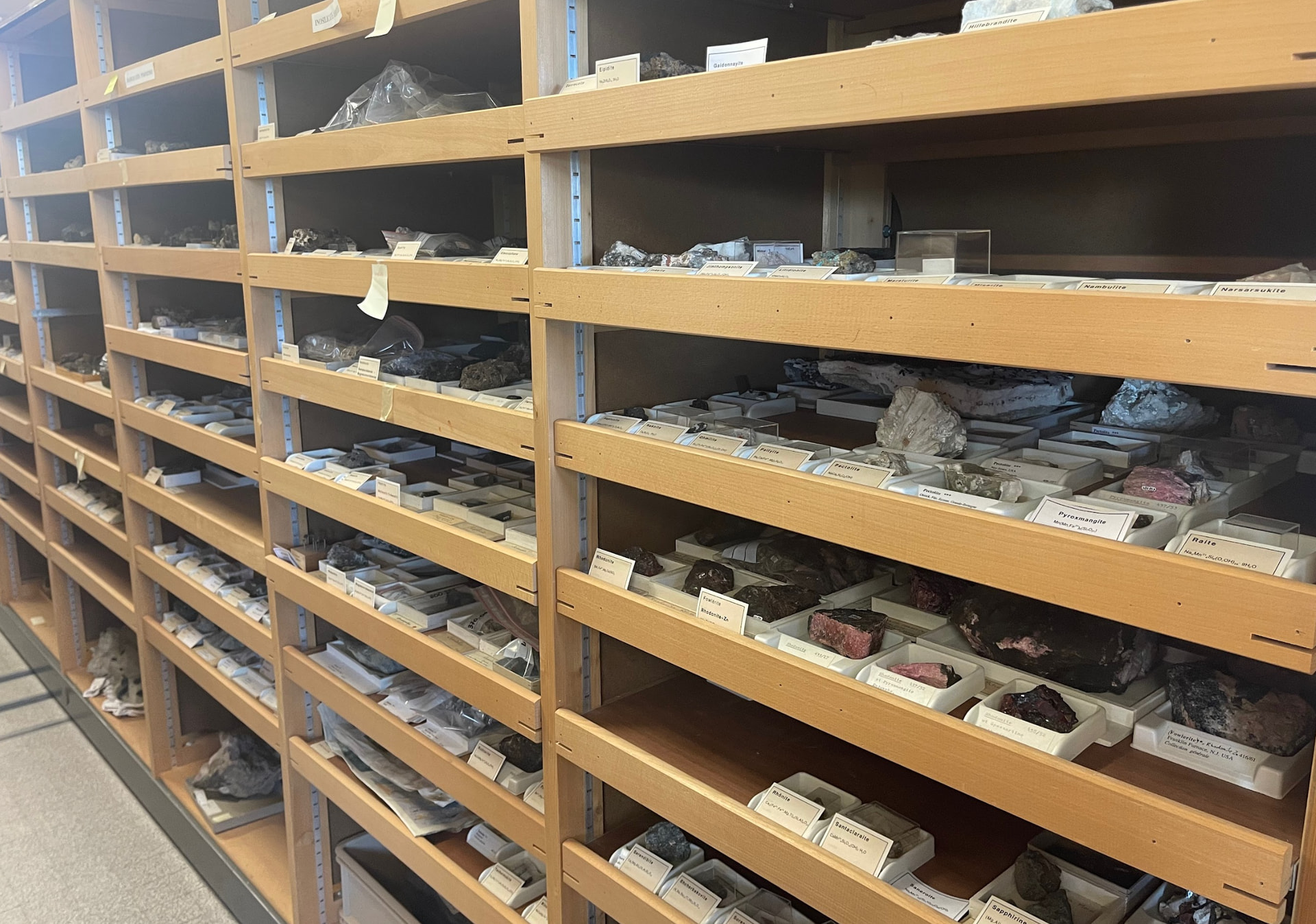


Our visit began in Geneva, where discussions focused on the complexities of mineralogical classification. We explored the necessity of supporting both Strunz and Dana classification systems simultaneously, a requirement that directly influenced the flexibility of the new Collection Object Types.
Nicolas Greber (Geologist) highlighted the need to search not just by name, but by chemical composition groups (e.g., Silicates, Oxides), giving us insight into how Specify needs to handle queryable attributes.
We spent time meeting with various curators of other biological disciplines to hear their feedback
Geneva Participants
- Alexis Beck – IT Manager, MHN Genève
- Nicolas Greber – Geologist
- Andres Herp – Herpetology
- Alice Cibois – Curator of Birds
- Manuel Ruedi – Curator of Mammals
- Laurent Vallotton – Deputy Head of Science
- Raoul Palese – Curator, CJBG (Botalista Project)
Natural History Museum of Basel (Naturhistorisches Museum Basel)
In Basel, the team met with André Puschnig and Loïc Costeur to discuss the migration from legacy systems (BioOffice and MS Access). A major focus here was Stratigraphy. The Basel team emphasized that searching for a geological age name (e.g., “Jurassic”) is insufficient; researchers need to query against the Chronostratigraphic Chart to find records within specific time ranges, even if the nomenclature has changed over time. This feedback was the primary driver for the Extended Age Queries and the International Chronostratigraphic Chart now available in Specify 7.12.
Basel Participants
- André Puschnig – Curator of Mineralogy
- Loïc Costeur – Head of Earth Sciences
- Florian Dammeyer – Collection Manager, Earth Sciences
- Lucas Blattner – Digitization & Postdoc
Natural History Museum of Bern (Naturhistorisches Museum Bern)


The challenge of the “compound specimen” was the central theme in Bern. Beda Hofmann and Ursula Menkveld-Gfeller presented numerous examples of “the matrix problem”- a single physical rock containing a fossil, a mineral, and a meteorite fragment.
They required a system that could assign a single Catalog Number to the rock while maintaining distinct, searchable identities for every item on it. This visit directly inspired the architecture of Components, allowing a single record to possess multiple distinct classifications (biological and geological) without creating artificial database records. We also analyzed their complex meteorite numbering systems, where pieces of a single fall are distributed globally but must remain linked.
Bern Participants
- Beda Hofmann – Head of Earth Sciences & Meteorites
- Thomas Burri – Scientific Collaborator
- Ursula Menkveld-Gfeller – Curator of Invertebrate Paleontology
- Eva Sprecher – Curator
- George Moyt – Staff
Cantonal Museum of Geology, Lausanne (Musée cantonal de géologie)


Our final stop in Lausanne provided a deep dive into data models. We reviewed their bespoke FileMaker Pro solution with curator Robin Marchant. This session was instrumental in defining how Collection Object Groups should function.
Lausanne’s workflow for handling artifacts, such as drilling cores (boreholes) and anthropogenic hazards (radioactive or toxic minerals), informed our new default pick lists for Hazards and Preservation Methods. The team also stressed the importance of tracking “Varieties” (e.g., distinguishing “Ruby” from “Corundum” while keeping them linked taxonomically), which refined our approach for the identification of minerals.
Lausanne Participants
- Gilles Borel – Chief Conservator
- Nicolas Meisser – Curator of Mineralogy / Petrology
- Robin Marchant – Curator of Geology & Geophysics
- Antoine Pictet – Curator of Paleontology
- Roland – Database Developer
- Julien – Mineralogy Student / Type Inventory
Getting Started with GeoSpecify
We invite SCC members and the broader geocollections community to explore these new features.
- Documentation: Comprehensive guides on configuring COTs, using Components, and managing Geologic Context are available in our documentation.
- Community Support: Join the discussion in the Discipline Hangouts > Earth Sciences category on the Speciforum to ask any questions you have.
- Get Started: Specify 7.12 is available now on GitHub and Docker Hub. If you have any questions or are getting started for the first time with Specify, please reach out to us at support@specifysoftware.org.
If you are interested in migrating a legacy geology database or need assistance setting up these new features, please contact our support team.